Rural-Urban Disparities in Epilepsy Outcomes in the United States
July 2026 | Neurology
Abstract
Background and Objectives
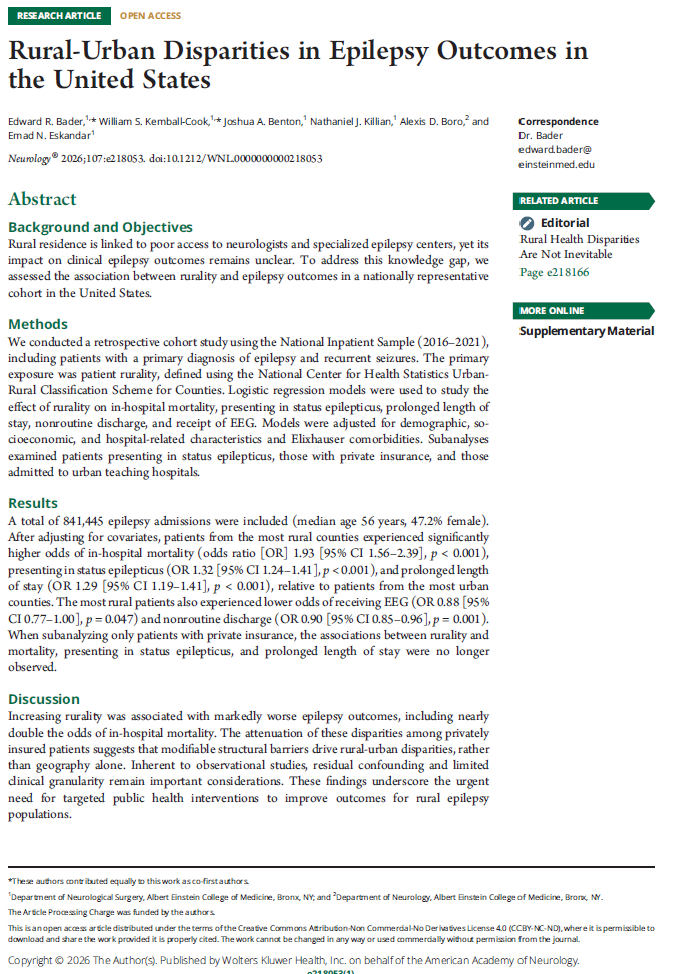
Rural residence is linked to poor access to neurologists and specialized epilepsy centers, yet its impact on clinical epilepsy outcomes remains unclear. To address this knowledge gap, we assessed the association between rurality and epilepsy outcomes in a nationally representative cohort in the United States.
Methods
We conducted a retrospective cohort study using the National Inpatient Sample (2016–2021), including patients with a primary diagnosis of epilepsy and recurrent seizures. The primary exposure was patient rurality, defined using the National Center for Health Statistics Urban-Rural Classification Scheme for Counties. Logistic regression models were used to study the effect of rurality on in-hospital mortality, presenting in status epilepticus, prolonged length of stay, nonroutine discharge, and receipt of EEG. Models were adjusted for demographic, socioeconomic, and hospital-related characteristics and Elixhauser comorbidities. Subanalyses examined patients presenting in status epilepticus, those with private insurance, and those admitted to urban teaching hospitals.
Results
A total of 841,445 epilepsy admissions were included (median age 56 years, 47.2% female). After adjusting for covariates, patients from the most rural counties experienced significantly higher odds of in-hospital mortality (odds ratio [OR] 1.93 [95% CI 1.56–2.39], p < 0.001), presenting in status epilepticus (OR 1.32 [95% CI 1.24–1.41], p < 0.001), and prolonged length of stay (OR 1.29 [95% CI 1.19–1.41], p < 0.001), relative to patients from the most urban counties. The most rural patients also experienced lower odds of receiving EEG (OR 0.88 [95% CI 0.77–1.00], p = 0.047) and nonroutine discharge (OR 0.90 [95% CI 0.85–0.96], p = 0.001). When subanalyzing only patients with private insurance, the associations between rurality and mortality, presenting in status epilepticus, and prolonged length of stay were no longer observed.
Discussion
Increasing rurality was associated with markedly worse epilepsy outcomes, including nearly double the odds of in-hospital mortality. The attenuation of these disparities among privately insured patients suggests that modifiable structural barriers drive rural-urban disparities, rather than geography alone. Inherent to observational studies, residual confounding and limited clinical granularity remain important considerations. These findings underscore the urgent need for targeted public health interventions to improve outcomes for rural epilepsy populations.

© 2026 Wolters Kluwer. All right reserved.